


 By
Short answer: A lightning protection layout decides where the air terminals (rods, conductors on the roof, masts) go so that every part of the structure sits inside a protected zone. IS/IEC 62305-3 allows three methods — the rolling sphere, the protection angle and the mesh — and the size of the sphere or mesh comes from the lightning protection level (LPL I to IV) your risk assessment selects.
Step zero: the protection level sets the numbers
Before drawing anything, the risk assessment (see lightning protection system design, step by step) fixes the class of LPS. That class drives every dimension on the layout:
| Class of LPS | Rolling sphere radius R | Mesh size | Typical down-conductor spacing |
|---|---|---|---|
| I | 20 m | 5 m × 5 m | 10 m |
| II | 30 m | 10 m × 10 m | 10 m |
| III | 45 m | 15 m × 15 m | 15 m |
| IV | 60 m | 20 m × 20 m | 20 m |
A smaller sphere means a stricter layout: more air terminals, closer together.
Method 1 — rolling sphere (works for any shape)
Imagine a ball of radius R rolled over and around the building in every direction. Wherever the ball touches the structure, a strike can attach, so that point needs an air terminal. Wherever the ball cannot reach — because rods, conductors or masts hold it off — is protected. It is the most general method and the one to use for complex roofs, tall buildings and plant areas.
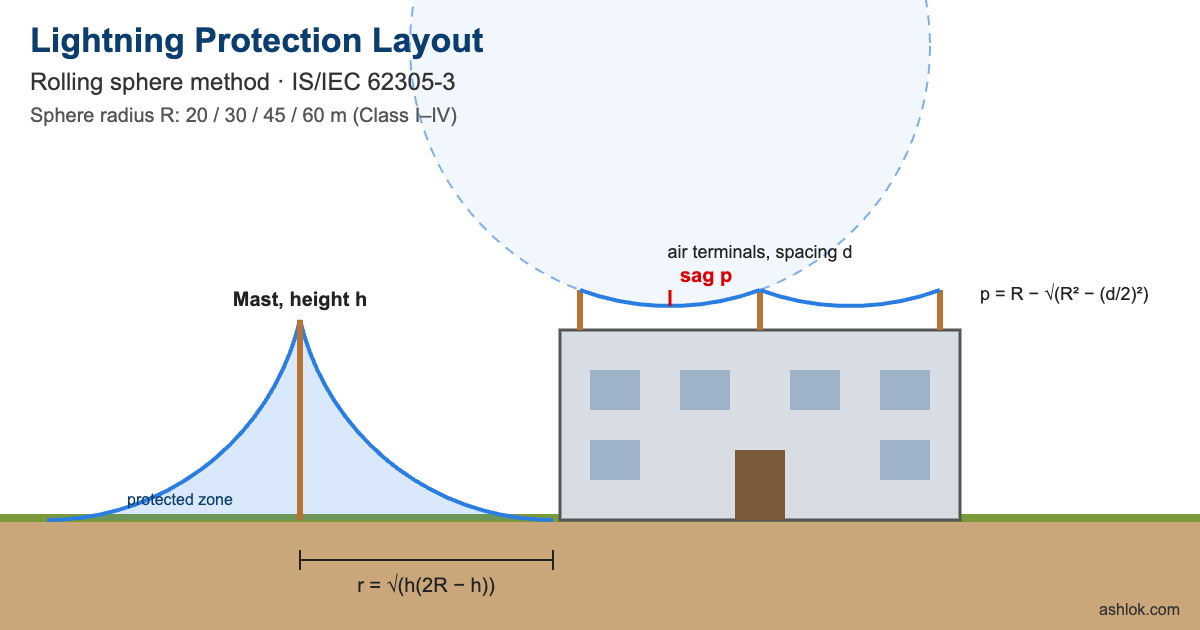
How far does the sphere dip between two rods?
Between two air terminals a distance d apart, the sphere sags down by
p = R − √(R² − (d/2)²)
Example: Class III (R = 45 m), rods 10 m apart → p = 45 − √(2025 − 25) ≈ 0.28 m. The rods must stand more than about 0.3 m above anything between them, or the sphere touches the roof.
Protected radius of a single mast
For a mast of height h (not taller than R), the sphere touches the ground at a horizontal distance
r = √(h × (2R − h))
Example: a 10 m mast, Class III → r = √(10 × 80) ≈ 28 m at ground level. At a height above ground the protected radius is smaller; subtract √(hₓ × (2R − hₓ)) for the height hₓ you need to cover. This is the core of any lightning mast design for tank farms, solar plants and open yards.
Method 2 — protection angle (simple shapes, short rods)
Each vertical air terminal protects a cone below it. The cone’s angle is read from the graph in IS/IEC 62305-3 and it gets narrower as the rod gets taller; above a height equal to the sphere radius the method does not apply at all. It is quick for small buildings, rooftop equipment and single rods, but on large or irregular roofs it tends to leave gaps that the rolling sphere would catch.
Method 3 — mesh (flat roofs)
For flat or gently sloping roofs, a grid of roof conductors with the mesh size from the table protects the surface. Run conductors along the roof edges and ridges first, keep the mesh no wider than the class allows, and add short rods for anything that pokes above the mesh — AC units, lift rooms, solar mounting frames. Rooftop solar has its own points to check: lightning arrester design for buildings and rooftop solar.
Turning the layout into a drawing
- Draw the roof plan and elevations to scale.
- Apply the method (often mesh on the flat roof plus rolling sphere for the edges and tall parts).
- Mark air terminals, roof conductors and down conductors at the spacing for your class, as symmetrical as the building allows and close to the corners.
- Give every down conductor a test joint and its own earth termination, then interconnect the earths — the earth pit target for lightning is usually under 10 Ω.
- Check separation distances to services and bond what cannot be separated; add surge protection on incoming lines (SPD types and classes).
Where ESE terminals fit
Early Streamer Emission terminals are laid out with their own radius-of-protection method under NFC 17-102, not with the rolling sphere radius above. If you are comparing the two approaches, read our ESE lightning arrester guide and types of lightning rods.
Frequently asked questions
What is the rolling sphere radius for Class IV?
60 m. Class I uses 20 m, Class II 30 m and Class III 45 m.
Which layout method is best?
The rolling sphere works for every shape and is the safest default; mesh is efficient on flat roofs; the protection angle method suits small, simple structures. Many real layouts combine them.
How many down conductors does a building need?
At least two, spaced around the perimeter at no more than the typical distance for the class (10 m for Classes I–II, 15 m for III, 20 m for IV), starting at the corners.
Can I design a lightning mast with the rolling sphere method?
Yes — use r = √(h(2R − h)) for the ground-level radius and check the radius at the height of the equipment you need to cover.
Who can supply the components?
Ashlok manufactures air terminals, conventional lightning protection components and complete lightning protection systems, plus the earthing behind them. Send your roof plan for a layout check — 094440 87356 or contact us.