


 By
By 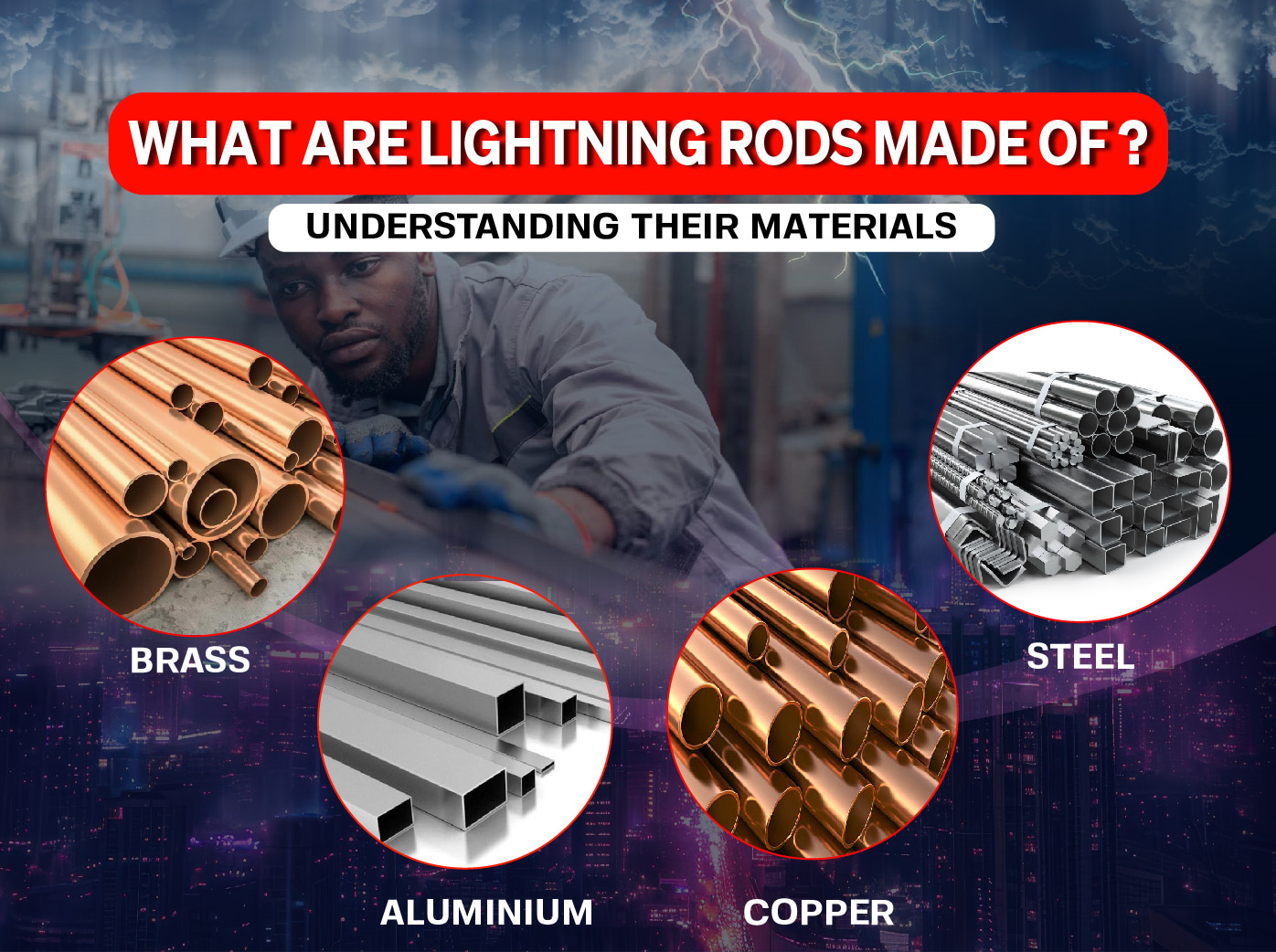
Lightning rods are made of highly conductive, corrosion-resistant metal — most often copper, copper-bonded steel, aluminium or stainless steel. Copper is the default because it combines the best conductivity with long outdoor life. Aluminium is used on aluminium-clad buildings to avoid bimetallic corrosion, and stainless steel is chosen for coastal, chemical and marine sites where salt or fumes would eat copper.
That is the short answer. Which of those metals is right for your building depends on the roof material, the atmosphere at the site and how the rod will be joined to everything below it. Below is the comparison, the installation rules that catch people out, and a checklist for choosing.
Lightning rod materials compared
An air terminal has to do two things: survive decades on a roof, and carry a very large current for a very short time without melting or breaking its joints. Those two demands are what narrow the field to four metals.
| Material | Conductivity (% IACS) | Density (g/cm³) | Melting point | Corrosion resistance | Typical use |
|---|---|---|---|---|---|
| Copper | 100% | 8.96 | ~1,085 °C | Very good (forms protective patina) | The default air terminal and down conductor |
| Copper-bonded steel | ~30–40% (steel core, copper surface) | 7.85 | ~1,450 °C (steel core) | Good while the copper layer is intact | Rods and earth electrodes where strength and cost matter |
| Aluminium | ~61% | 2.70 | ~660 °C | Good in air, poor in soil and in contact with copper | Aluminium-clad roofs and façades; above-ground runs only |
| Stainless steel (304/316) | ~2.5% | 7.90 | ~1,400–1,450 °C | Excellent, including salt air | Coastal, marine and chemical plants; architectural finishes |
| Brass / bronze | ~28% | ~8.5 | ~900–940 °C | Very good | Clamps, bases and fittings rather than the rod itself |
Copper and copper-bonded steel: the default choice
Copper is the reference material for lightning protection. It has the highest conductivity of the practical options, it weathers to a stable patina instead of flaking away, and it joins cleanly to copper down conductors and copper earth electrodes — which removes the dissimilar-metal problem at every connection in the system.
Solid copper rods are expensive, so many installations use copper-bonded steel: a steel core for mechanical strength, with copper metallurgically bonded to the surface to carry the surge and resist corrosion. The thing to check is the copper thickness. A thin electroplated coat wears through and the steel beneath rusts; a properly bonded coating is specified in microns and is what gives the rod its service life. The same logic applies below ground, which is why copper-bonded earthing rods are specified by coating thickness rather than by diameter alone — we cover that in detail in our guide to what a copper-bonded earthing rod is.
Aluminium: where it belongs, and where it must not go
Aluminium carries about 61% of copper’s conductivity but weighs less than a third as much, so an aluminium conductor of equivalent current-carrying capacity is lighter and easier to fix to a roof. On an aluminium roof or façade it is also the correct choice, because running copper across aluminium cladding sets up galvanic corrosion that will damage the building long before it damages the lightning protection system.
Two rules matter:
- Aluminium does not go into the ground, and should not be run close to ground level where it sits in damp soil, mortar or rainwater splash. It corrodes rapidly in those conditions. The transition to copper or copper-bonded steel is made above that zone.
- Aluminium and copper must never be joined directly. Where the two meet, use a bimetallic connector so the dissimilar metals are separated. A direct aluminium-to-copper joint outdoors will corrode and the resistance of the joint will climb — which is exactly what you do not want in the one path the surge is meant to take.
Stainless steel: for coastal and corrosive sites
Stainless steel is a poor conductor — roughly 2.5% of copper — so it is never chosen for conductivity. It is chosen because it survives. On a seafront building, a fertiliser plant or a refinery, salt spray and acidic fumes will attack copper and destroy aluminium, while 304 or 316 stainless keeps its surface and its strength for decades. Architects also like it because it stays bright rather than turning green.
Because of the low conductivity, stainless components are sized with a larger cross-section than the copper equivalent. The standards allow the substitution; they just require the extra metal.
Brass and bronze: fittings more than rods
Brass and bronze appear throughout a lightning protection system, but usually as clamps, bases, couplers and test-link hardware rather than as the air terminal itself. They machine well, thread well and resist corrosion, which makes them ideal for the parts that have to be tightened, opened and inspected — such as the earthing test link where the down conductor meets the earth electrode.
The rod is only one part of the system
It is worth saying plainly: the material of the air terminal matters far less than whether the rest of the path is continuous. A lightning protection system is an air termination, a set of down conductors and an earth termination, all bonded together. A perfect copper rod bolted to a corroded joint or a high-resistance earth pit protects nothing.
If you are specifying a system rather than replacing a rod, start with lightning arrester design for buildings, and check the earth side against a measured earthing resistance value. Tall structures have their own complications, covered in lightning protection for tall buildings.
How to choose the right material for your site
- Look at the roof. Aluminium cladding → aluminium. Copper or mixed roofing → copper or copper-bonded steel.
- Look at the air. Within a few kilometres of the sea, or downwind of a chemical process → stainless steel for the exposed parts.
- Check every junction for dissimilar metals. Every aluminium-to-copper meeting point needs a bimetallic connector.
- Keep aluminium above the damp zone. Transition to copper-bonded steel before ground level.
- Specify coating thickness, not just diameter, for any copper-bonded component.
- Confirm the cross-section against the current edition of the standard you are working to (IS/IEC 62305-3 in India, with NBC 2016 Part 8 for building requirements). Each material has its own minimum, and stainless needs more metal than copper.
Frequently asked questions
Are lightning rods made of copper?
Most are, either as solid copper or as copper-bonded steel. Copper has the highest conductivity of the practical materials and weathers well, and using copper throughout avoids dissimilar-metal joints between the rod, the down conductor and the earth electrode.
Why are lightning rods not made of iron or ordinary steel?
Bare steel rusts. Galvanised steel is used in some systems and is permitted by the standards, but the zinc layer is sacrificial and has a finite life outdoors; copper-bonded steel gives the same mechanical strength with a far more durable conductive surface.
Can I mix copper and aluminium in one lightning protection system?
Yes, but only through bimetallic connectors at the transition. A direct copper-to-aluminium joint exposed to weather will corrode and the joint resistance will rise, which defeats the purpose of the conductor.
Does the material of the rod affect how much lightning it attracts?
No. A lightning rod does not attract strikes; it provides a preferred, low-impedance attachment point for a strike that was already going to happen nearby, and a safe path to earth. Material affects durability and current-carrying capacity, not the likelihood of a strike.
How long does a lightning rod last?
Decades, if the material suits the environment and the joints are inspected. In practice systems fail at connections and at the earth termination long before the air terminal itself wears out, which is why periodic inspection and an earth-resistance test matter more than the rod’s age.
Specifying lightning protection for your building
Ashlok has manufactured earthing and lightning protection products in India since 1999. If you are choosing between materials for a specific site, our team can review the roof construction, the atmosphere and the earthing arrangement together rather than in isolation.
Explore Ashlok lightning protection systems, conventional lightning protection and the THOR lightning rod, or talk to our team about your site.
