


 By
By 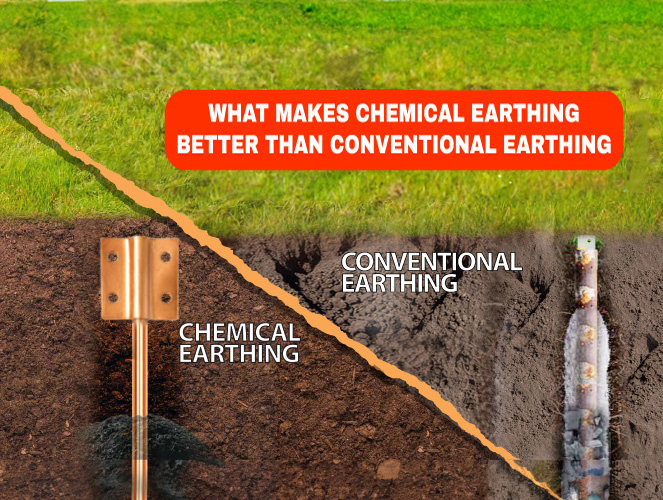
Conventional earthing uses a GI or copper plate or pipe surrounded by alternate layers of salt and charcoal; chemical (maintenance-free) earthing uses a treated electrode with a stable, non-leaching backfill compound. The practical difference shows up after year two: a conventional pit’s resistance climbs as the salt leaches away and it needs regular watering, while a properly installed chemical electrode holds its value with no routine maintenance. Conventional earthing is cheaper to install; chemical earthing is usually cheaper to own.
What is conventional earthing?
Conventional earthing is the traditional method: a galvanised iron or copper plate or pipe is buried in a pit and surrounded by alternate layers of common salt and charcoal. The salt lowers the resistivity of the soil immediately around the electrode and the charcoal helps retain moisture, so the pit reads a usable value when it is first commissioned.
Why salt and charcoal are used
Soil conducts through the moisture and dissolved salts it holds, not through the soil particles themselves. Adding salt increases the number of free ions around the electrode, and charcoal holds water in place. Together they create a small treated zone that carries current far better than the surrounding earth.
The problem with conventional earthing
Salt is water-soluble, which is exactly why it works — and exactly why it does not last. Every monsoon washes some of it out of the backfill, so the treated zone shrinks and the resistance climbs. That is why a conventional pit needs periodic watering and re-salting, and why its readings drift upward year on year. The same salt also accelerates corrosion of the electrode it is meant to be helping.
What is chemical earthing?
A chemical or maintenance-free earthing electrode is a treated GI or copper-bonded pipe containing a crystalline compound, installed with a low-resistance backfill compound around it instead of salt and charcoal. The compound is designed to be hygroscopic and non-leaching: it draws and holds moisture from the surrounding soil without dissolving away, so the treated zone stays put.
Because nothing is washing out, the resistance stays broadly stable across seasons and years, and there is no watering schedule to keep to. The electrode types available, and where each fits, are covered in our guide to types of earthing electrodes.
Chemical earthing vs conventional earthing: the comparison
| Conventional earthing | Chemical / maintenance-free earthing | |
|---|---|---|
| Electrode | GI or copper plate or pipe | Treated GI or copper-bonded electrode with internal compound |
| Backfill | Alternate layers of salt and charcoal | Stable low-resistance backfill compound (non-leaching) |
| Resistance over time | Rises as the salt leaches out | Stays broadly stable |
| Routine maintenance | Periodic watering; periodic re-salting | None in normal service |
| Seasonal variation | Pronounced — readings drift in the dry season | Much reduced |
| Effect on the electrode | Salt accelerates corrosion | Compound designed to be non-corrosive to the electrode |
| Installation cost | Lower | Higher |
| Cost of ownership | Recurring watering, testing and earlier replacement | Lower over the design life |
| Best suited to | Moist soil, low-criticality loads, tight capital budget | Rocky, sandy or dry soil; critical loads; pits that are hard to reach |
Where chemical earthing is used
- Difficult soil — rocky, sandy, lateritic or made-up ground, where a conventional pit simply will not reach an acceptable value.
- Critical installations — sub-stations, data centres, hospitals and process plants, where an earth that drifts is not acceptable.
- Lightning protection earth terminations, which need a dependable low-impedance path and are often in awkward locations.
- Sites where nobody can water a pit — remote towers, rooftops, sealed courtyards and unmanned installations.
When conventional earthing is still the right choice
Chemical earthing is not automatically correct, and it is worth saying so plainly. If the soil stays moist year round, the load is not critical, someone is genuinely available to water and test the pit, and the capital budget is tight, a well-made conventional pit will do the job.
The case for switching is strongest where one of these is true:
- The soil is rocky, sandy, lateritic or made-up ground and readings will not come down.
- Readings drift upward every dry season and the pit is re-salted repeatedly.
- The pit is somewhere nobody can reach easily to water it.
- The load is critical — a sub-station, a data centre, medical equipment, or a lightning protection earth.
Whichever you install, the test that settles it is the measured value in the dry season. See what earth resistance value is acceptable and how to check earthing resistance.
Frequently asked questions
What is conventional earthing?
An earth pit built around a GI or copper plate or pipe, backfilled with alternate layers of common salt and charcoal to reduce the resistance of the surrounding soil. It is the traditional method described in older Indian practice and is still widely installed.
Is chemical earthing really maintenance free?
It removes the routine watering and re-salting a conventional pit needs. It does not remove the need for periodic testing — you should still measure and log the resistance annually, because that value is the only evidence the earth is doing its job.
Why does a conventional earth pit’s resistance keep rising?
Salt is water-soluble. Every monsoon washes some of it out of the backfill, so the treated zone around the electrode shrinks and the resistance climbs. Watering restores it temporarily; re-salting restores it for longer; neither is permanent.
Can I convert an existing conventional pit to chemical earthing?
In most cases yes — the electrode and backfill are replaced while the existing conductor run, test link and chamber are reused. Measure the pit first: if the high reading is coming from a corroded joint rather than the soil, replacing the electrode will not fix it.
Which lasts longer, chemical or conventional earthing?
A chemical electrode generally holds a usable value for far longer, because nothing is leaching out of the backfill and the compound is not attacking the electrode. Actual service life depends on soil chemistry, electrode material and coating thickness — check the manufacturer’s stated design life and warranty rather than assuming a figure.
Choosing the right earthing for your site
Ashlok has manufactured earthing electrodes and backfill compounds in India since 1999, including for rocky and sandy sites where conventional pits will not hold a value. If your readings are drifting upward year on year, that is usually a sign the pit design — not the tester — is the problem.
See Ashlok safe earthing electrodes, the Baron backfill compound and copper-bonded earthing rods, or send us your site details and current readings.
